
Words shape understanding. Some words look simple on the surface yet carry precise meanings underneath. Adjacent is one of those words. You see it in math textbooks, real estate listings, legal documents, and everyday conversations. Still, many people pause and wonder what it really means in each context.
Adjacent means next to or beside something else.
It describes things that are very close together, often sharing a side, edge, or boundary.
Let’s clear the fog.
This guide explains “what does adjacent mean,” how people use it in real life, and why its meaning changes slightly in math, geometry, and angles. You’ll also see examples, comparisons, and quick-reference tables so everything sticks.
Meaning of Adjacent in Simple Terms
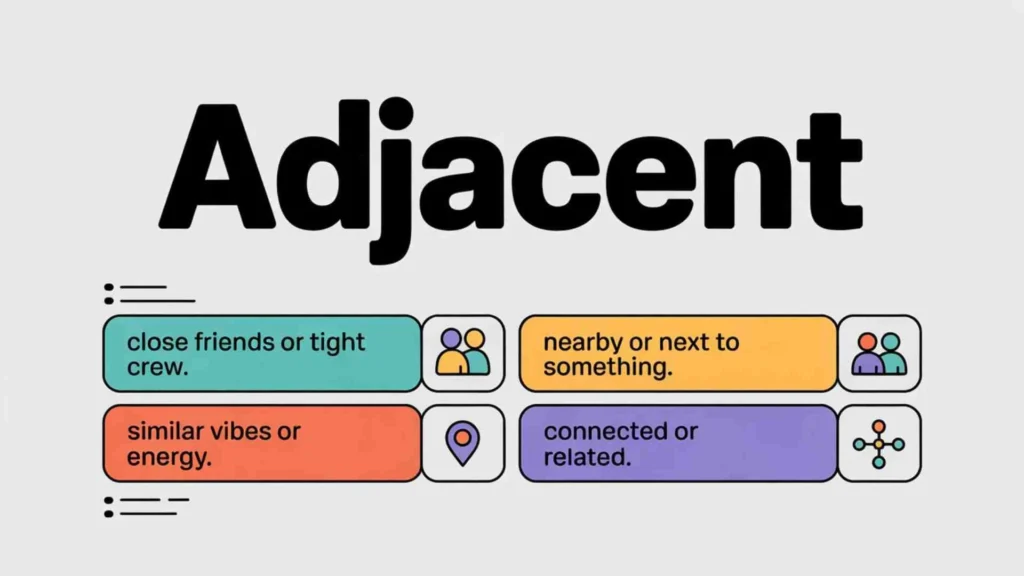
At its core, adjacent means next to or beside something else.
However, it’s more precise than words like “near” or “close.” Adjacent usually implies a direct relationship between two things.
- They are positioned side by side
- They are very close
- They often share a border, edge, or point
Imagine two houses sharing a fence. Those houses are adjacent.
Now imagine two houses on the same street but separated by several lots. They’re nearby, not adjacent.
That distinction matters.
Adjacent Mean in Different Ways

What Does Adjacent Mean in Math?
In math, especially in geometry, adjacent means “next to” or “touching.”
For example:
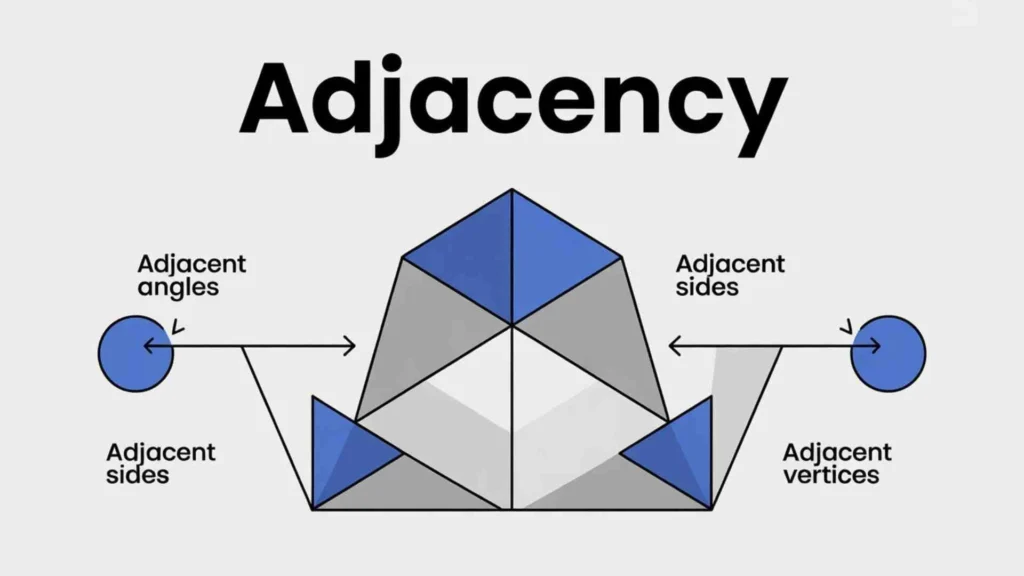
- Adjacent angles are two angles that share a common side and a common vertex.
- In a right triangle, the adjacent side is the side next to a given angle (but not the hypotenuse).
In simple terms, if two shapes, sides, or angles share a boundary or point, they are adjacent.
Adjacent Example
Here are simple examples of how “adjacent” is used:
- Two houses built next to each other are adjacent houses.
- In a classroom, the student sitting beside you is in the adjacent seat.
- In geometry, two squares sharing a common side are adjacent shapes.
In every case, adjacent means directly next to something.
Adjacent Synonym
Common synonyms for adjacent include:
- Next to
- Neighboring
- Beside
- Bordering
- Touching
- Near
However, not all synonyms work in every situation. For example, “neighboring” works for houses, but not always for angles in math.
Adjacent Wall Meaning
An adjacent wall refers to a wall that is directly next to another wall or space.
For example:
- In an apartment, the wall you share with your neighbor is an adjacent wall.
- In a room, two walls that meet at a corner are adjacent walls.
It simply means the wall is touching or connected.
Adjacent Person Meaning
An adjacent person usually means someone sitting or standing next to you.
Example:
- “Please give the paper to the adjacent person.”
- “The adjacent passenger helped me.”
It describes physical closeness, not emotional closeness.
Does Adjacent Mean Diagonal?
No, adjacent does not usually mean diagonal.
Adjacent means directly next to and touching.
Diagonal means positioned across at an angle and usually not touching directly side-by-side.
For example:
- A house next door is adjacent.
- A house across the street at an angle is diagonal, not adjacent.
In geometry, adjacent angles share a side, while diagonal lines cross corners.
Adjacent Side Meaning
In trigonometry, the adjacent side is the side next to a specific angle in a right triangle — but it is not the hypotenuse.
In simple terms:
- Pick an angle in a right triangle.
- The side touching that angle (other than the hypotenuse) is the adjacent side.
This term is commonly used in sine, cosine, and tangent calculations.
Adjacent House Meaning
An adjacent house is a house located directly next to another house.
For example:
- “The adjacent house was recently sold.”
- “Our adjacent neighbors are very friendly.”
It simply means the house shares a boundary or is immediately beside another.
What Does Adjacent Mean in Everyday Language?
In daily conversation, people use adjacent to describe physical closeness with clarity.
You’ll hear it when someone wants to avoid confusion.
Common Everyday Examples
- “The restroom is adjacent to the elevator.”
- “Our hotel room is adjacent to the pool.”
- “She sat in the seat adjacent to mine.”
- “The parking lot is adjacent to the building.”
In each case, the word removes ambiguity. You don’t have to guess how close “close” really is.
Origin and Etymology of the Word Adjacent
Understanding where a word comes from often explains how it behaves.
Adjacent comes from the Latin word adjacere.
- ad = toward
- jacere = to lie
So the original meaning was “to lie near” or “to lie next to.”
Over time, English adopted the term and refined it. Instead of vague closeness, adjacent became a word of precision, especially in academic and technical fields.
That’s why lawyers, engineers, architects, and mathematicians love it.
Adjacent vs Similar Words
People often confuse adjacent with other words that seem interchangeable. They aren’t always.
Here’s how they differ.
Adjacent vs Nearby
- Adjacent: right next to, often sharing a boundary
- Nearby: close, but not necessarily touching
A café across the street is nearby.
A café inside the same building is adjacent.
Adjacent vs Adjoining
- Adjacent: next to or very close
- Adjoining: directly connected or touching
Adjoining rooms share a door.
Adjacent rooms might share a wall but no door.
Adjacent vs Bordering
- Adjacent: next to
- Bordering: sharing a clear boundary
All bordering areas are adjacent.
Not all adjacent areas are bordering.
What Does Adjacent Mean in Math?
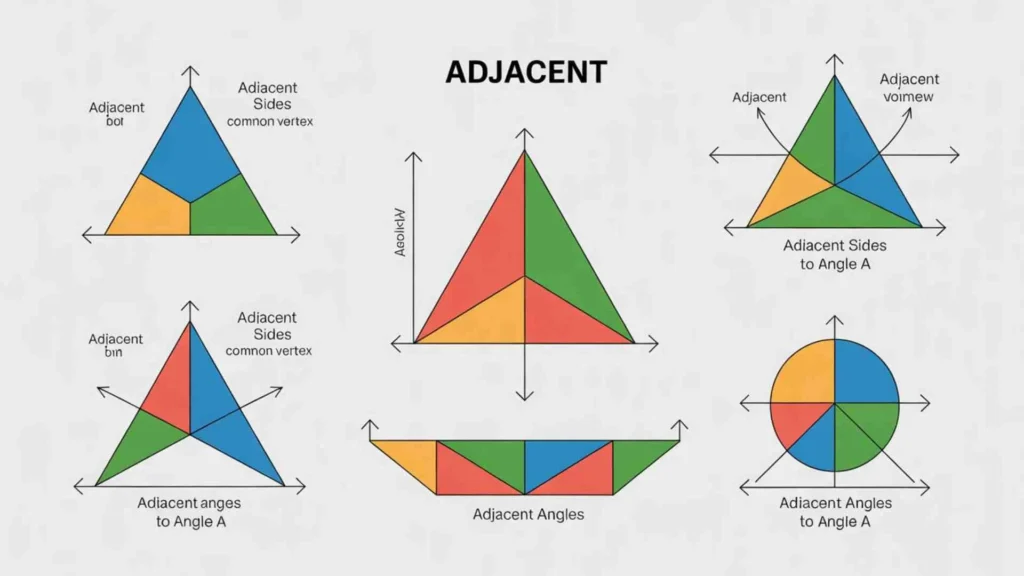
In mathematics, words must behave consistently. Adjacent takes on a stricter definition here.
In math, adjacent objects:
- Are next to each other
- Share a common part
- Do not overlap
This precision helps eliminate guesswork.
Common Mathematical Uses
- Adjacent angles
- Adjacent sides
- Adjacent numbers in sequences
- Adjacent shapes
Students often struggle when they bring everyday meanings into math problems. Math doesn’t allow that flexibility.
What Does Adjacent Mean in Geometry?
Geometry relies heavily on the concept of adjacency.
In geometric terms, adjacent means two elements are next to each other and share something specific.
Adjacent Sides
Adjacent sides share a common endpoint.
Think of a square. Each side touches two other sides. Those touching sides are adjacent.
Adjacent Shapes
Two shapes are adjacent if:
- They touch at an edge or vertex
- They don’t overlap
For example, two rectangles sharing a side are adjacent shapes.
Adjacent Vertices
Vertices are points where lines meet. If two shapes share a vertex, those vertices are adjacent.
What Does Adjacent Mean in Angles?
This is where most people encounter confusion.
Adjacent Angles Explained
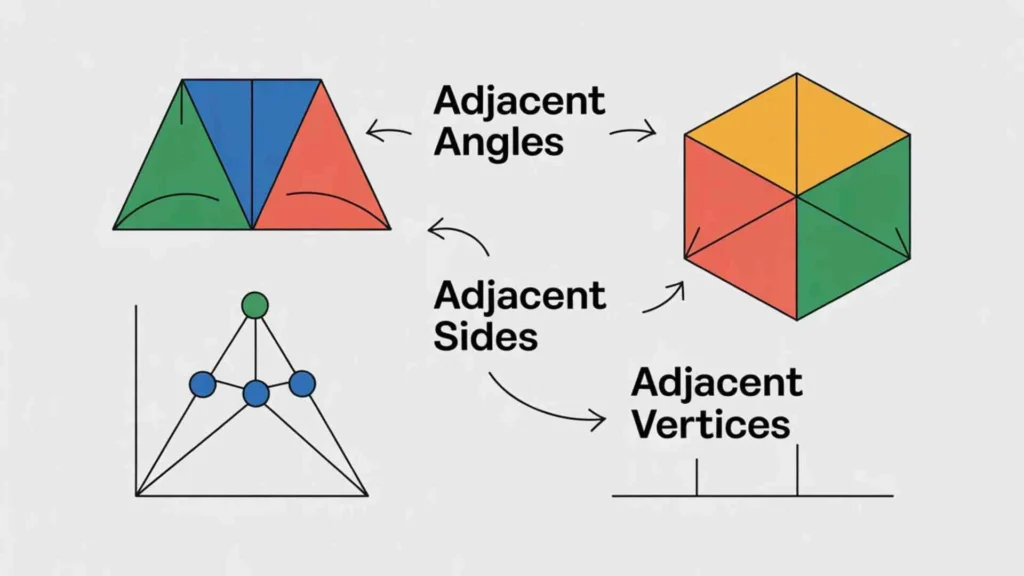
Adjacent angles are angles that:
- Share a common vertex
- Share one side
- Sit next to each other
- Do not overlap
Picture a clock. The angle between 12 and 3 is adjacent to the angle between 3 and 6. They touch at the same center point and share a side.
Properties of Adjacent Angles
- They sit side by side
- They may add up to a larger angle
- They are often part of supplementary angles
Adjacent does not mean opposite. That’s a different concept entirely.
Adjacent vs Vertical Angles
These two get mixed up constantly.
| Feature | Adjacent Angles | Vertical Angles |
| Position | Side by side | Opposite |
| Shared side | Yes | No |
| Shared vertex | Yes | Yes |
| Overlap | No | No |
Understanding this difference alone can prevent dozens of math errors.
Adjacent in Real-World Professional Contexts
Outside classrooms, adjacent carries legal and financial weight.
Architecture and Construction
Architects use adjacent to describe room placement and flow.
- Adjacent rooms improve accessibility
- Adjacent structures may require fire separation rules
One word can influence safety compliance.
Urban Planning and Land Use
City planners use adjacent to define zoning rules.
- Adjacent properties may share restrictions
- Adjacent land use affects noise and traffic laws
Law and Property Boundaries
In legal documents, adjacent removes ambiguity.
A property described as adjacent to a river may have specific rights or restrictions. Courts rely on that wording.
Common Mistakes People Make With Adjacent
Even fluent speakers misuse the word.
Mistake One: Assuming Adjacent Always Means Touching
Adjacent often means touching, but not always. Context decides.
Mistake Two: Using Adjacent When “Nearby” Fits Better
If two objects aren’t directly next to each other, adjacent is incorrect.
Mistake Three: Misusing Adjacent in Geometry Problems
If two angles overlap, they are not adjacent. Period.
Examples of Adjacent Used in Sentences
Everyday Examples
- “The pharmacy is adjacent to the grocery store.”
- “He booked a seat adjacent to the aisle.”
Academic Examples
- “The two theories are adjacent in concept.”
- “The chapters are adjacent in the textbook.”
Math Examples
- “Angle A is adjacent to Angle B.”
- “These two sides are adjacent sides of the triangle.”
Quick Reference Table: Adjacent Meanings by Context
| Context | Meaning |
| Everyday English | Next to or beside |
| Mathematics | Next to and sharing a common part |
| Geometry | Touching at a side or vertex |
| Angles | Side-by-side with a shared vertex |
| Law | Directly next to with legal relevance |
Why Understanding “Adjacent” Matters
Words guide decisions.
Misunderstanding adjacent can cause:
- Math mistakes
- Legal disputes
- Construction errors
- Confusing directions
Understanding it saves time and prevents costly misunderstandings.
Adjacent in Figurative and Abstract Use
Sometimes, adjacent isn’t physical.
- “The idea is adjacent to the main topic.”
- “Her role is adjacent to management.”
Here, adjacent means closely related but not identical.
Adjacent vs Related Concepts in Language
Let’s separate a few ideas clearly.
- Adjacent: next to
- Related: connected in meaning
- Associated: loosely linked
Precision matters. Writers who use adjacent correctly sound sharper and clearer.
Teaching Tip
Here’s a simple trick.
If two things can high-five, they’re adjacent.
If they can only wave, they’re nearby.
Silly? Yes. Effective? Also yes.
Final Summary
It means next to, beside, or directly close, often with a shared edge, side, or point.
- In everyday English, it clarifies location
- In math and geometry, it defines strict relationships
- In professional fields, it carries legal and technical weight
Once you understand it, you’ll notice how often it appears. And now, you’ll use it correctly every time.
Discover More Topics:
- Find out What Does ISTG Mean in Text Viral Slang Everyone Should Understand in 2026
- Find out What Does SYFM Meaning Slang, Definition, Usage, and Online Context for 2026
- Explanation of What Does EYP Mean Complete Meaning In Text Slang And Uses for 2026

Ethan Cole is a writer fueled by emotions, driven by truth, and inspired by the power of words. Known for his ability to distill complex feelings into short, striking lines, Ethan has become a go-to name for readers seeking comfort, motivation, and clarity through quotes.
With a background in literature and a lifelong love for poetic expression, Ethan blends simplicity with depth. He writes not just to be read, but to be felt. His work dives into themes of heartbreak, healing, mental strength, and the beauty of being human — making his words resonate across generations.
Ethan believes that even a single sentence, when written with honesty, can become a turning point in someone’s life. Whether it’s a quote to mend a shattered heart or one to spark a dream, he crafts each line with intention.
Outside the world of writing, he enjoys black coffee, rainy evenings, and observing life in its rawest form — because that’s where the real stories hide.
📚 Published Works by Ethan Cole
“Fragments of a Shattered Sun”A poetic journey through heartbreak, loss, and the light that follows even the darkest nights.
“Ink & Resilience”A bold mix of motivational quotes and raw reflections on self-growth, courage, and rising again.
“The Weight of Quiet Things”A deeply personal collection of short quotes and musings for those who feel deeply but speak softly.