
Have you ever looked at two shapes and wondered if they’re exactly the same? In geometry, the term congruent answers that question.
Congruent shapes are identical in both size and shape, meaning you can place one on top of the other, and they’ll match perfectly.
Understanding congruency is essential—not just for solving math problems—but for real-life tasks like tiling a floor, designing graphics, or folding origami. In this guide, you’ll learn everything about congruent shapes, their properties, proofs, symbols, and practical applications.
Basic Definition of Congruent
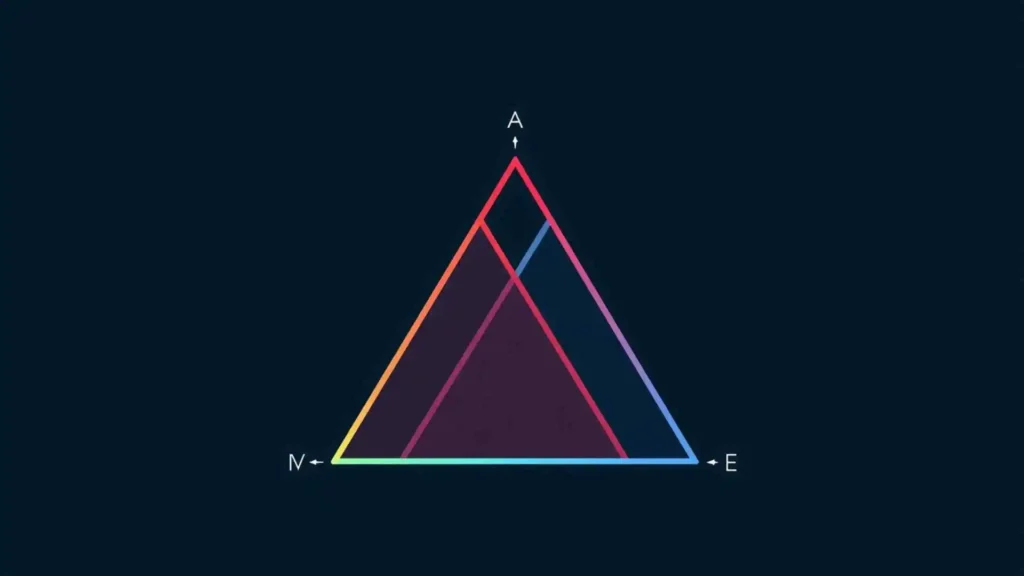
In simple terms, congruent means “exactly the same in size and shape.”
- If two triangles have equal sides and angles, they are congruent.
- If a square and another square have identical sides, they are congruent.
It’s important not to confuse congruent with similar. Similar shapes share the same shape but can differ in size. For example, a small triangle and a large triangle with the same angles are similar, but only identical-sized triangles are congruent.
Everyday examples:
- Matching tiles on a floor
- Playing cards in a deck
- Identical stickers or stamps
Key Characteristics of Congruent Shapes
Every congruent shape shares certain defining features:
- Congruent sides – All corresponding sides have equal lengths.
- Congruent angles – All corresponding angles measure the same.
- Correspondence – Each side and angle matches one in the other shape.
- Identical size and shape – Overlap perfectly if superimposed.
- Mirror image possibility – Shapes can be flipped and still be congruent.
Tip: If any one of these characteristics fails, the shapes are not congruent.
Symbols and Notation
Geometry has shorthand to represent congruence:
- ≅ – “is congruent to”
- Example: ΔABC ≅ ΔDEF
- ≙ – “corresponds to”
- Example: AB ≙ DE
These symbols are used in proofs or when labeling diagrams. Correct notation helps communicate clearly in math problems and textbooks.
Types of Congruent Shapes
Triangles
Triangles are the most common shapes studied for congruence. They have three sides and three angles, making it easier to check congruency.
Quadrilaterals
Squares, rectangles, and parallelograms can be congruent if all sides and angles match.
Polygons
Any polygon—pentagon, hexagon, or octagon—can be congruent if every side and angle corresponds exactly.
Visual Tip: Overlaying shapes on top of each other helps recognize congruency instantly.
Congruence in Triangles
Triangles have special rules that make proving congruency easier. These are called triangle congruence postulates:
| Postulate | Description | How it works |
| SSS (Side-Side-Side) | Three sides of one triangle equal three sides of another | ΔABC ≅ ΔDEF if AB=DE, BC=EF, AC=DF |
| SAS (Side-Angle-Side) | Two sides and the included angle are equal | ΔABC ≅ ΔDEF if AB=DE, ∠B=∠E, BC=EF |
| ASA (Angle-Side-Angle) | Two angles and the included side are equal | ΔABC ≅ ΔDEF if ∠A=∠D, AB=DE, ∠B=∠E |
| AAS (Angle-Angle-Side) | Two angles and a non-included side are equal | ΔABC ≅ ΔDEF if ∠A=∠D, ∠B=∠E, BC=EF |
| HL (Hypotenuse-Leg) | For right triangles only, hypotenuse and one leg equal | ΔABC ≅ ΔDEF if AC=DF (hypotenuse) and AB=DE (leg) |
Example:
If you know two sides and the included angle of one triangle match another triangle, you can confidently say they’re congruent.
Congruence in Quadrilaterals
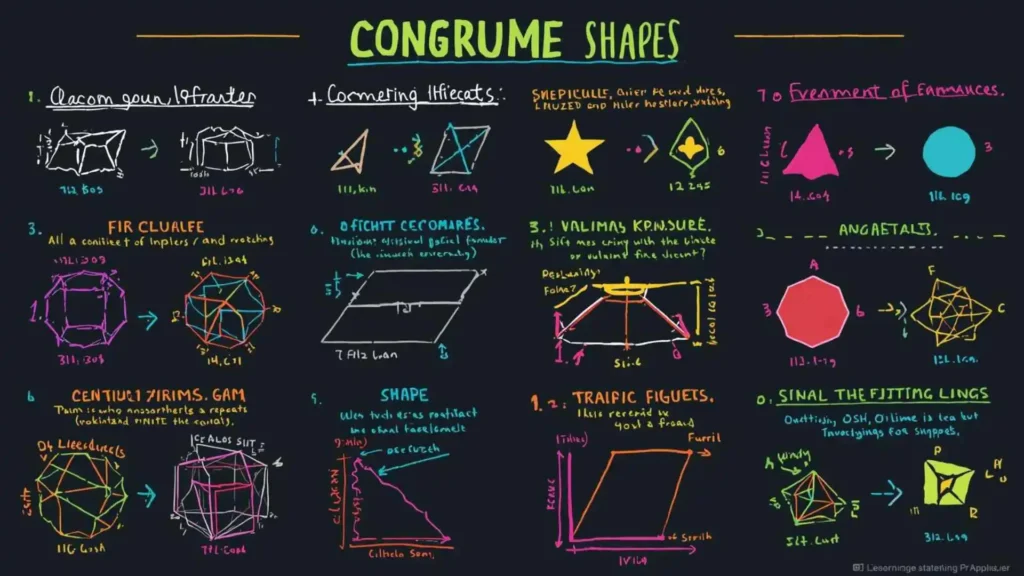
Quadrilaterals can also be congruent, but the process is slightly different:
- Equal side lengths – All four sides match.
- Equal angles – All four angles match.
- Diagonals and symmetry – Sometimes diagonals can prove congruency.
Examples:
- Two squares with sides 5 cm each
- Two rectangles measuring 3×6 cm each
Tip: Use a ruler or measurement tool for accuracy.
Geometric Theorems and Proofs
Congruence plays a critical role in geometry proofs.
- You can calculate unknown angles or sides using congruence rules.
- For complex figures, identify corresponding sides and angles first.
- Proofs often use triangle congruence postulates as the main logic.
Quick Example:
If ΔABC ≅ ΔDEF, then AB=DE, AC=DF, ∠A=∠D, and so on. This knowledge can help solve for unknowns in geometry problems.
Practical Applications of Congruency
Congruence isn’t just a textbook concept. It appears in daily life:
- Architecture & construction – Matching tiles, beams, or panels.
- Art & design – Identical shapes in patterns, graphics, and logos.
- Origami – Folding identical shapes requires congruency.
- Math practice – Exercises in congruency strengthen spatial reasoning.
- Software tools – Apps like DreamBox Math and GeoGebra provide interactive congruence exercises.
Recognizing Congruent Shapes
Here’s how to identify congruency quickly:
- Visual overlay – Place one shape on top of another.
- Measure sides and angles – Use a ruler and protractor.
- Check correspondence – Ensure every side and angle matches.
- Flip or rotate – Remember, orientation doesn’t matter for congruence.
Common Mistakes and Misconceptions
Even experienced students make mistakes with congruency:
- Confusing congruent with similar.
- Assuming shapes must face the same direction.
- Forgetting to check all sides and angles.
- Mislabeling corresponding parts in diagrams.
Tip: Always verify every side and angle before declaring shapes congruent.
Practice Exercises
Try these exercises to test your understanding:
- Identify congruent triangles in the diagram below:
ΔABC: AB=5, BC=7, AC=6
ΔDEF: DE=5, EF=7, DF=6
Answer: ΔABC ≅ ΔDEF (SSS)
- Check if these quadrilaterals are congruent:
- Square 1: 4×4
- Square 2: 4×4
Answer: Congruent
- Match corresponding sides and angles in labeled polygons.
- Solve for unknown angles using ASA, SAS, or HL postulates.
Conclusion
Congruence is a cornerstone of geometry. It allows you to compare shapes, prove theorems, and solve problems efficiently. From triangles to polygons, congruent figures appear in classrooms, construction sites, and even in art and design. Once you master congruency, you gain a powerful tool to understand and navigate the world of shapes, measurements, and spatial reasoning.

Asher Blake is a passionate wordsmith whose pen dances between pain and purpose. Known for his emotionally rich quotes and soul-stirring reflections, Asher has become a quiet force in the world of inspirational writing. His words don’t just decorate pages — they reach into hearts, offering comfort, clarity, and courage.
With a background in creative writing and an unshakable love for literature, Asher began his journey by collecting forgotten feelings and turning them into lines that linger. His work touches on self-worth, healing, love, heartbreak, and the small moments that define us. He believes that even a single sentence can light up someone’s darkest day.
Driven by empathy and depth, Asher Blake writes not to impress — but to connect. His quotes are shared across the globe by those searching for meaning, motivation, and emotional release. Whether you’re lost in love, rebuilding your confidence, or simply pausing to breathe, his words feel like they were written just for you.
Books by Asher Blake
“Ink & Ache: Quotes That Feel Like Scars”
A collection of raw, emotional quotes about love, loss, and becoming whole again.
“Still Learning to Breathe”
An inspiring blend of healing quotes and reflections for anyone learning to let go.
“Unfinished Thoughts”
A poetic journey through scattered emotions, fleeting moments, and the beauty of not having all the answers.