
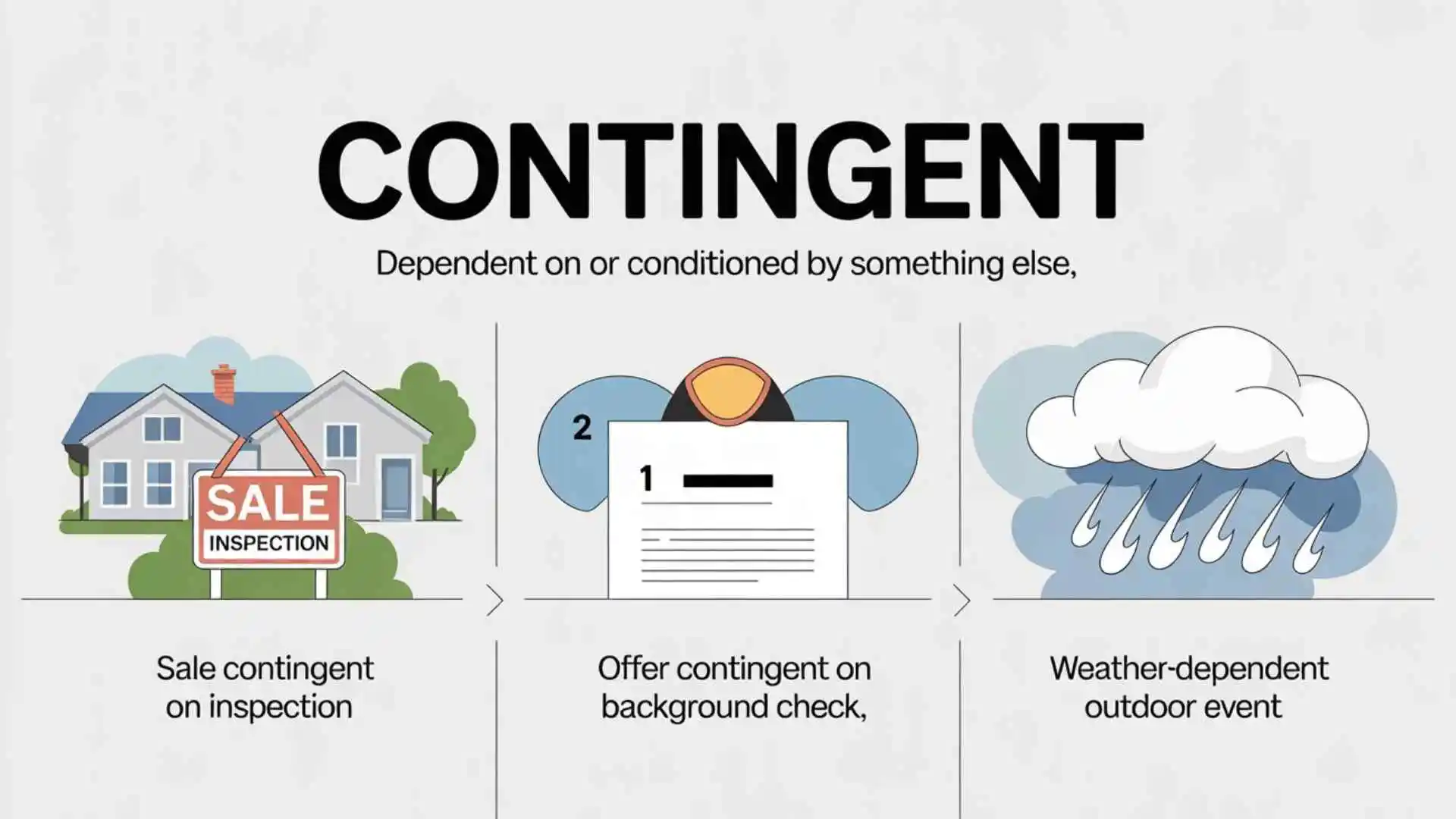
Understanding the term contingent can be confusing because its meaning changes depending on the context.
If you see it in real estate listings, business contracts, legal documents, or casual conversation, knowing the exact definition and proper usage is essential.
This guide breaks down everything you need to know about what contingent means, its real-world applications, and practical examples.
The Simple Definition of Contingent
At its core, contingent meaning is dependent on something else happening. In simpler terms, something is contingent if it might happen, but only if certain conditions are met.
The word originates from Latin contingere, which means “to touch” or “be connected,” highlighting that the outcome depends on another factor.
Key Points:
- Conditional – only happens if a requirement is met.
- Dependent – reliant on another event or action.
- Possible but not guaranteed – not absolute.
Example:
Your acceptance into a scholarship program may be contingent upon submitting your final grades.
Everyday Uses of Contingent
You don’t have to be a lawyer or real estate agent to encounter contingent in daily life. Here are some practical scenarios:
- Work: “Your promotion is contingent on completing the project successfully.”
- School: “Your field trip participation is contingent on parental permission.”
- Travel: “Your hotel booking is contingent upon payment confirmation.”
- Personal decisions: “Dinner plans are contingent on whether it rains tonight.”
By seeing it in context, you’ll quickly grasp the conditional nature of the word.
Contingent in Real Estate
Real estate is where the word “contingent” is most searched. Many buyers and sellers wonder: what does contingent mean in real estate?
What Is a Contingent Offer?
A contingent offer meaning refers to a home purchase proposal that depends on certain conditions being met. Until these conditions are satisfied, the sale is not final.
Common Real Estate Contingencies

Here’s a breakdown of typical contingencies in property deals:
- Financing contingency – The buyer must secure a loan.
- Home inspection contingency – The property must pass inspection.
- Appraisal contingency – The home must appraise at the purchase price.
- Home sale contingency – The buyer must sell their current home first.
- Title contingency – The title must be clear of liens or disputes.
Example:
A home listed as contingent may still accept backup offers in case the original buyer fails to meet the conditions.
Contingent vs. Pending
Many people confuse contingent with pending. Here’s a clear comparison:
| Term | Meaning | Can You Make an Offer? |
| Contingent | Sale depends on conditions | Sometimes (backup offers) |
| Pending | All conditions met; awaiting closing | No |
Pro Tip: A contingent listing signals the deal isn’t 100% finalized, whereas pending means the deal is essentially locked in.
Contingent in Business
In business contexts, contingent meaning often appears in contracts, work arrangements, and financial reporting.
- Contingent workforce – Employees hired temporarily or conditionally.
- Contingent liability – A potential obligation that depends on a future event.
- Contingent contract – A contract whose performance depends on a specific occurrence.
- Contingent assets – Assets that may or may not materialize based on conditions.
Example:
A contingent liability might include a pending lawsuit that could cost the company money if the outcome is unfavorable.
Contingent in Law
Legal documents frequently use contingent to specify conditional rights or obligations.
- Contingent beneficiary: A backup beneficiary who receives benefits only if the primary beneficiary cannot.
- Contingent fee: A lawyer’s payment that depends on winning a case.
Example:
“The inheritance is contingent upon the beneficiary reaching 25 years of age.”
Contingent in Grammar
Grammatically, contingent is often used with upon:
- Example: “Your acceptance is contingent upon meeting all requirements.”
- You can also simplify: “Your acceptance depends on meeting all requirements.”
Tip: Using “contingent on/upon” is formal; casual alternatives include “depends on” or “based on.”
Synonyms and Related Words
Here are words that are similar to contingent. Use them carefully depending on context:
- Conditional – Often interchangeable.
- Dependent – Stresses reliance on something else.
- Provisional – Temporary or tentative.
- Tentative – Suggests uncertainty.
- Subject to – Formal alternative in contracts.
Antonyms: Opposite of Contingent
To clarify its meaning, understanding opposites helps:
- Certain – Guaranteed outcome.
- Unconditional – No conditions attached.
- Independent – Not reliant on anything else.
- Guaranteed – Absolutely assured.
How to Use “Contingent” in Sentences
Here are practical examples for clarity:
- Your job offer is contingent upon passing a background check.
- The sale of the car is contingent on a successful inspection.
- Participation in the event is contingent on registration approval.
- Incorrect: “The concert is contingent tomorrow.” ❌ (Missing condition explanation)
- Corrected: “The concert is contingent on weather conditions.” ✅
Common Mistakes People Make
Many misuse contingent in casual speech:
- Thinking contingent means canceled.
- Confusing it with temporary or provisional.
- Using “contingent upon” in everyday speech without a clear condition.
- Overusing it in legal documents or contracts unnecessarily.
Frequently Asked Questions (FAQ)
What does contingent mean in simple terms?
Something is contingent if it depends on another event or condition.
Does contingent mean sold in real estate?
Not yet. It means an offer exists but conditions must be met first.
Can a contingent offer fall through?
Yes, if the buyer or seller fails to satisfy the conditions.
Is contingent good or bad?
Neutral—it only signals that certain requirements must be fulfilled.
What does contingent upon mean?
It means “depends on” or “subject to” something happening first.
Why Contingent Meaning Changes by Context
The meaning of contingent varies due to lexical ambiguity—words can shift meaning depending on their context:
- Legal context: formal conditions in contracts.
- Business context: workforce, liabilities, or assets.
- Real estate context: purchase offers and sales process.
- Casual conversation: general dependency or uncertainty.
Insight: Context is everything. The same word may indicate uncertainty, dependency, or a formal condition.
Real-World Examples Across Domains
Real Estate:
A home listed as contingent may still attract backup offers.
Business:
A contingent workforce helps companies scale operations during peak demand.
Law:
Contingent beneficiaries ensure estates are distributed if the primary beneficiary cannot inherit.
Grammar/Everyday Life:
“Plans are contingent on the weather” is clear and conversational.
Tables and Lists for Quick Reference
Common Contingent Phrases
| Phrase | Meaning | Example |
| Contingent upon | Depends on | “Offer is contingent upon inspection.” |
| Contingent offer | Real estate proposal | “The house is under a contingent offer.” |
| Contingent liability | Potential obligation | “Pending lawsuit = contingent liability.” |
| Contingent worker | Temporary employee | “The project hires contingent workers.” |
Synonyms and Antonyms Quick Guide
| Synonyms | Antonyms |
| Conditional | Certain |
| Dependent | Independent |
| Provisional | Unconditional |
| Tentative | Guaranteed |
| Subject to | Definite |
Contingent in Cultural and Linguistic Contexts
Understanding contingent meaning is also important in language evolution and social dynamics. In sociolinguistics, words like contingent show semantic shift—their meaning adapts depending on age group, culture, or field.
- Cultural linguistics: Professionals use it formally, casual speakers may misinterpret it.
- Lexical ambiguity: The exact meaning changes with context.
- Behavioral feedback loop modeling: Repetition of usage in business or law reinforces formal interpretation.
Conclusion: What Contingent Really Means
In short, contingent = dependent on conditions. Whether in real estate, business, law, or daily conversation, the key is context. A contingent offer, contingent liability, or contingent plan all point to an outcome that is possible, but not guaranteed. By understanding the term clearly and seeing real-world examples, you can confidently use contingent in the right way every time.

Asher Blake is a passionate wordsmith whose pen dances between pain and purpose. Known for his emotionally rich quotes and soul-stirring reflections, Asher has become a quiet force in the world of inspirational writing. His words don’t just decorate pages — they reach into hearts, offering comfort, clarity, and courage.
With a background in creative writing and an unshakable love for literature, Asher began his journey by collecting forgotten feelings and turning them into lines that linger. His work touches on self-worth, healing, love, heartbreak, and the small moments that define us. He believes that even a single sentence can light up someone’s darkest day.
Driven by empathy and depth, Asher Blake writes not to impress — but to connect. His quotes are shared across the globe by those searching for meaning, motivation, and emotional release. Whether you’re lost in love, rebuilding your confidence, or simply pausing to breathe, his words feel like they were written just for you.
Books by Asher Blake
“Ink & Ache: Quotes That Feel Like Scars”
A collection of raw, emotional quotes about love, loss, and becoming whole again.
“Still Learning to Breathe”
An inspiring blend of healing quotes and reflections for anyone learning to let go.
“Unfinished Thoughts”
A poetic journey through scattered emotions, fleeting moments, and the beauty of not having all the answers.