
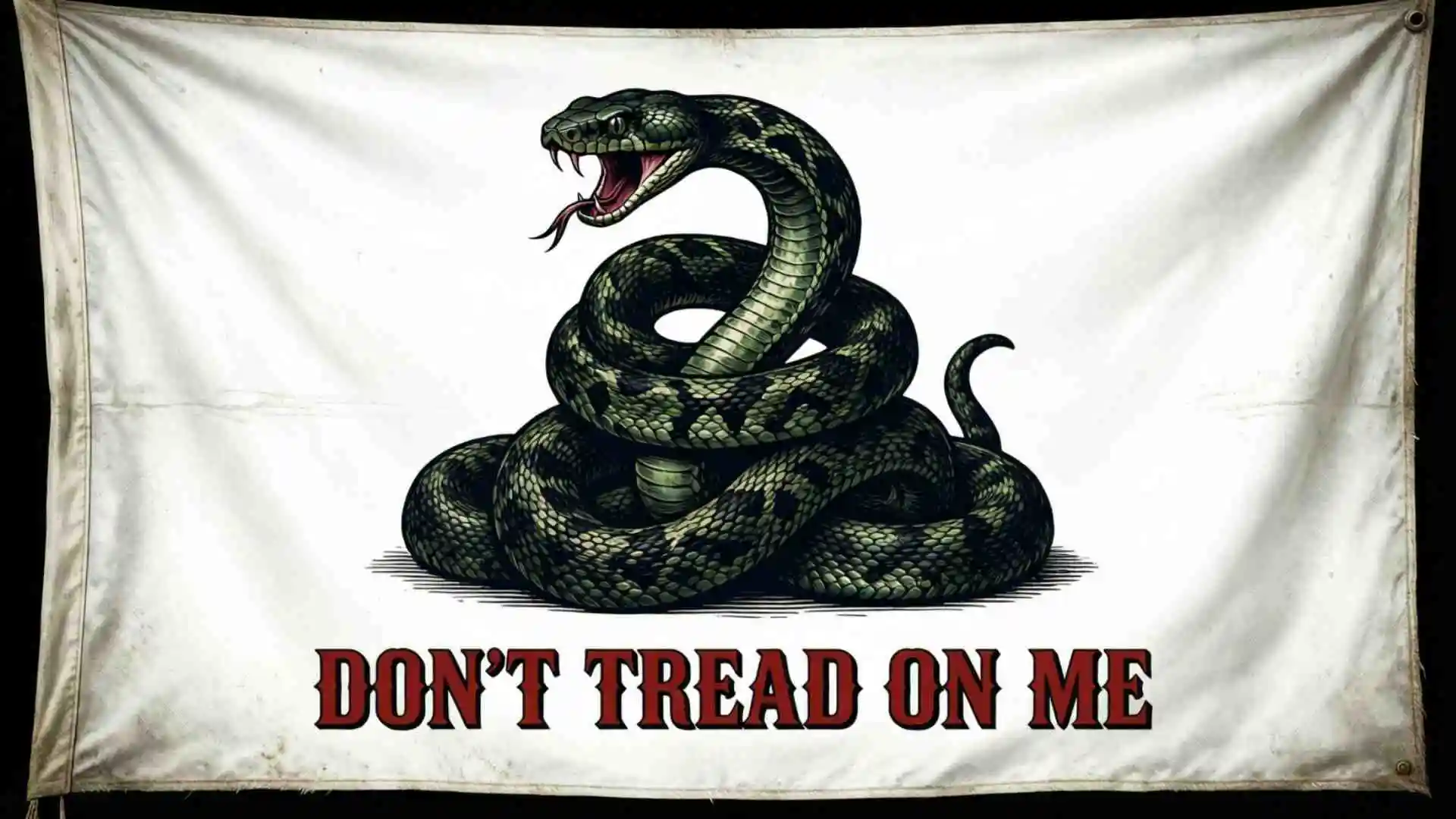
Few phrases in American history carry as much weight, emotion, and controversy as Don’t Tread on Me. You’ve probably seen it on a bright yellow flag with a coiled rattlesnake.
Maybe it was on a bumper sticker, a T-shirt, or flying at a rally. And at some point, you likely wondered: what does Don’t Tread on Me mean, really?
The short answer feels simple. The deeper meaning runs through American history, military tradition, politics, and modern cultural debates. This guide breaks it all down clearly, honestly, and without fluff.
By the end, you’ll understand what does Don’t Tread on Me mean, why it was created, how the military uses it, what it means in politics, and how people interpret it today—in simple terms.
What Does Don’t Tread On Me Mean
At its core, Don’t Tread on Me is a warning.
It means:
Do not threaten my freedom, rights, or autonomy—or expect resistance.
The phrase communicates a firm boundary. It doesn’t invite conflict, but it makes one thing clear: oppression will be met with defense.
Unlike slogans that encourage aggression, Don’t Tread on Me focuses on self-defense, vigilance, and personal liberty. The message isn’t “attack first.” It’s “leave me alone.”
This meaning hasn’t changed since the phrase first appeared in the 1700s.
Simple Meaning Of Don’t Tread On Me
In everyday language, the phrase means:
- Don’t control me
- Don’t take away my rights
- Don’t push past my limits
- Don’t interfere with my freedom
Think of it like a fence sign that says Private Property. It isn’t hostile. It’s a boundary.
In simple terms:
Don’t Tread on Me means “respect my freedom, or I’ll defend it.”
That simplicity is exactly why the phrase still resonates centuries later.
Historical Origins Of Don’t Tread On Me
To understand the phrase fully, you have to go back to 1775, right before the American Revolution exploded into full conflict.
At the time, the American colonies lived under British rule. The British government imposed taxes, controlled trade, stationed troops, and limited colonial self-governance.
Colonists increasingly felt trampled—politically, economically, and personally.
The phrase Don’t Tread on Me emerged as a symbolic response to that pressure.
It wasn’t about rebellion for rebellion’s sake. It was about resisting tyranny.
The Gadsden Flag Explained
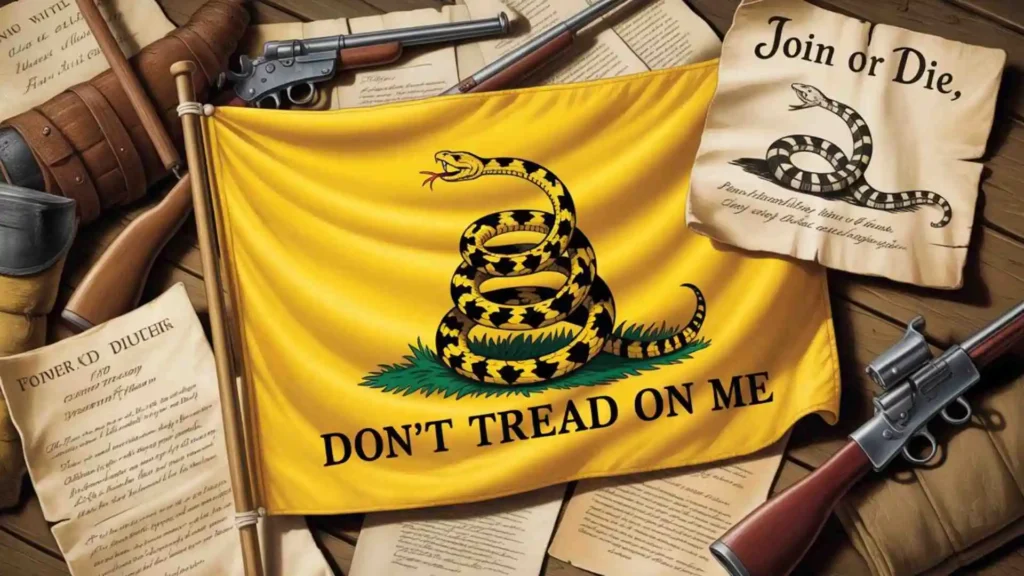
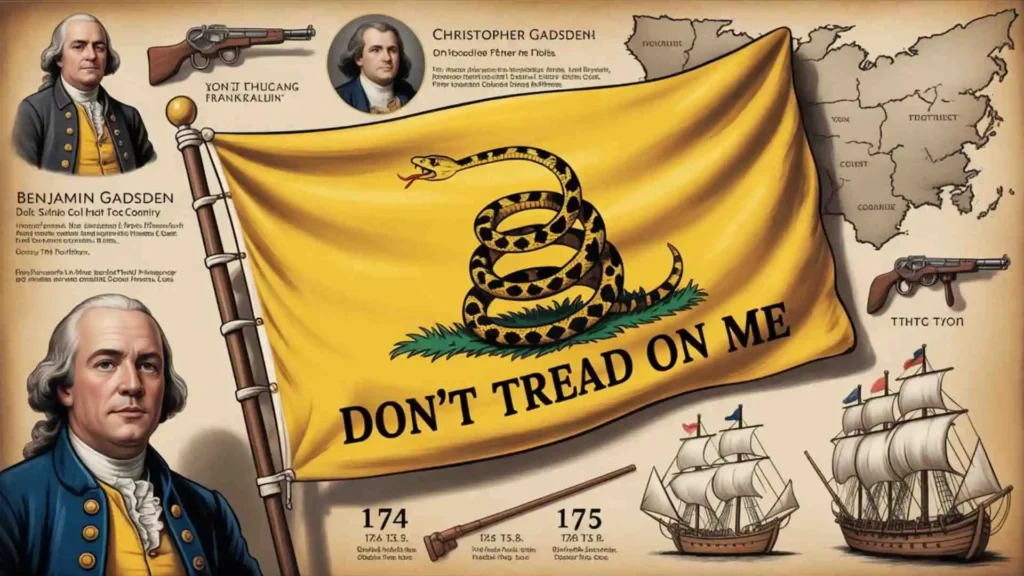
The phrase became famous through the Gadsden flag, one of the most recognizable symbols in American history.
Key facts about the Gadsden flag:
| Element | Meaning |
| Designer | Christopher Gadsden |
| Year created | 1775 |
| Original use | Continental Marines |
| Background color | Yellow (warning color) |
| Symbol | Coiled rattlesnake |
| Motto | Don’t Tread on Me |
Christopher Gadsden was a South Carolina politician and general. He presented the flag to the Continental Marines, making it one of the first military flags of the United States.
The design wasn’t random. Every detail sent a message.
Meaning Of The Rattlesnake Symbol
The rattlesnake was a deliberate choice, not decoration.
At the time, the rattlesnake symbolized the American colonies for several reasons:
- Native to North America
- Peaceful unless provoked
- Deadly when threatened
- Gives a warning before striking
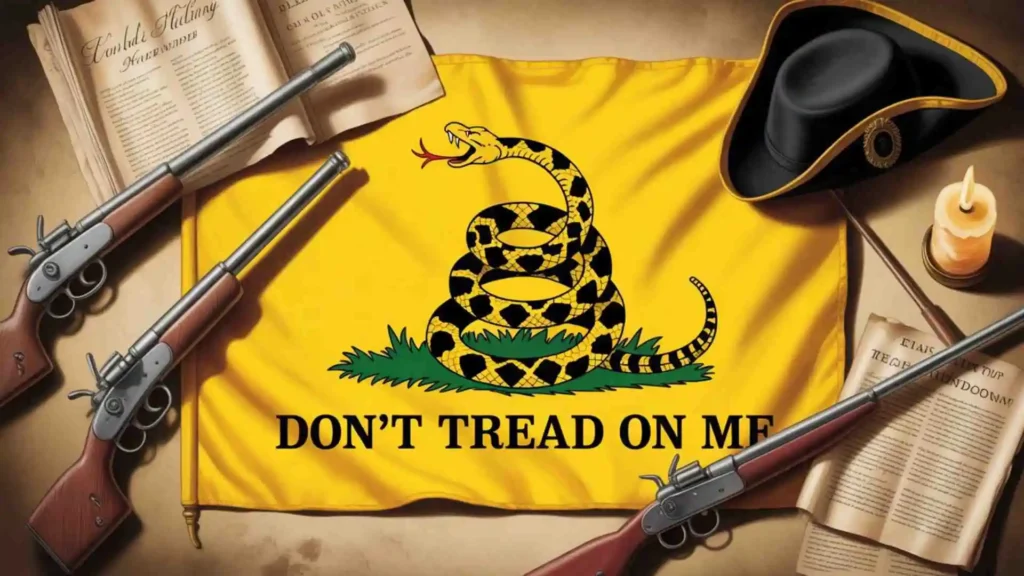
The image shows the snake coiled, not attacking. That posture matters.
Symbolic breakdown:
- Coiled posture → readiness, not aggression
- Rattle → warning before action
- Venom → consequences if ignored
Benjamin Franklin even wrote about the rattlesnake as a symbol of American character—patient, alert, and dangerous only when stepped on.
That symbolism aligns perfectly with the message: Don’t Tread on Me.
What Don’t Tread On Me Meant During The American Revolution
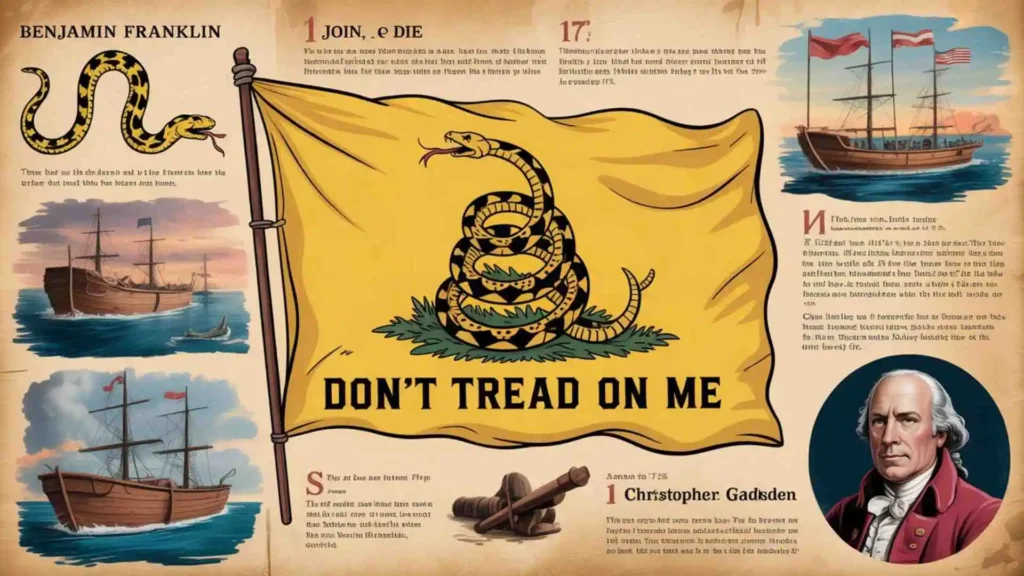
During the Revolution, the phrase carried a very specific message to Britain.
It said:
- We don’t seek violence
- We want autonomy
- Push us further, and we’ll fight
The flag unified the colonies under a shared warning. It wasn’t a call for chaos. It was a declaration of limits.
For colonial soldiers, the phrase represented:
- Resistance to forced control
- Defense of self-governance
- Willingness to stand ground
In many ways, Don’t Tread on Me was psychological warfare. It told the enemy exactly where the line was.
What Does Don’t Tread On Me Mean In The Military
Today, the phrase still holds meaning in military culture, though its use is more symbolic than official.
You’ll see Don’t Tread on Me in:
- Military patches
- Unit flags
- Training environments
- Veteran communities
In a military context, it generally represents:
- Strength through restraint
- Readiness without provocation
- Defense rather than conquest
For service members, the message often translates to:
We don’t seek conflict, but we’re prepared for it.
It emphasizes deterrence, not dominance.
What Does Don’t Tread On Me Mean In Politics
Politics is where interpretations start to split.
In modern political usage, Don’t Tread on Me often represents:
- Individual liberty
- Limited government
- Opposition to perceived overreach
Many people display it to express:
- Distrust of centralized authority
- Desire for personal autonomy
- Commitment to constitutional rights
However, the phrase itself isn’t tied to a single political party. Different groups use it differently, which fuels confusion and controversy.
Modern Uses Of Don’t Tread On Me
Today, the phrase appears everywhere.
Common modern uses include:
- Flags and banners
- Clothing and accessories
- Stickers and decals
- Social media imagery
People use it to communicate:
- Patriotism
- Independence
- Defiance against control
In the digital age, Don’t Tread on Me functions almost like shorthand—a visual sentence that says a lot without words.
Controversies Surrounding Don’t Tread On Me
Despite its historical roots, the phrase isn’t universally accepted today.
Some controversies include:
- Association with extremist groups
- Use in highly polarized political protests
- Misinterpretation as aggressive rather than defensive
Critics argue that modern usage sometimes strays far from the original intent. Supporters counter that misuse doesn’t erase historical meaning.
Both views exist simultaneously.
Common Misunderstandings About Don’t Tread On Me
Several myths surround the phrase.
Misconception: It promotes violence
Reality: It promotes deterrence and defense
Misconception: It’s anti-government
Reality: It’s anti-tyranny, not anti-law
Misconception: It’s extremist
Reality: It originated as a unifying revolutionary symbol
Context changes perception. The phrase itself stays the same.
What Don’t Tread On Me Means In Simple Terms Today
If you had to explain it to a child or someone unfamiliar with U.S. history, you could say:
“Don’t mess with my freedom.”
That’s it.
Everything else—flags, debates, politics—flows from that simple idea.
Frequently Asked Questions
Is Don’t Tread on Me patriotic?
Yes. It comes directly from America’s founding era.
Is it political?
It can be, depending on how and where it’s used.
Why is it controversial?
Because modern groups use it in different ways.
Is it still used by the military?
Yes, symbolically, though not as an official flag.
Final Thought
After nearly 250 years, the phrase still carries power.
- Freedom matters
- Boundaries exist
- Resistance follows oppression
Its message hasn’t softened. It hasn’t disappeared. And it hasn’t lost relevance.
If viewed as a historic warning or a modern statement, it remains one of the most enduring expressions of liberty in American culture—short, sharp, and impossible to ignore.
Also Check These Posts
- What Does “Huzz” Mean | A Complete Parent-Aware Guide to the Viral Slang for 2026
- What Does ENM Mean | A Complete Guide to ENM in Dating and Relationships for 2026

Ethan Cole is a writer fueled by emotions, driven by truth, and inspired by the power of words. Known for his ability to distill complex feelings into short, striking lines, Ethan has become a go-to name for readers seeking comfort, motivation, and clarity through quotes.
With a background in literature and a lifelong love for poetic expression, Ethan blends simplicity with depth. He writes not just to be read, but to be felt. His work dives into themes of heartbreak, healing, mental strength, and the beauty of being human — making his words resonate across generations.
Ethan believes that even a single sentence, when written with honesty, can become a turning point in someone’s life. Whether it’s a quote to mend a shattered heart or one to spark a dream, he crafts each line with intention.
Outside the world of writing, he enjoys black coffee, rainy evenings, and observing life in its rawest form — because that’s where the real stories hide.
📚 Published Works by Ethan Cole
“Fragments of a Shattered Sun”A poetic journey through heartbreak, loss, and the light that follows even the darkest nights.
“Ink & Resilience”A bold mix of motivational quotes and raw reflections on self-growth, courage, and rising again.
“The Weight of Quiet Things”A deeply personal collection of short quotes and musings for those who feel deeply but speak softly.