
Understanding the word proficient goes far beyond a dictionary definition. In today’s globalized world, being proficient can shape your career opportunities, personal growth, and even your language journey.
If it’s mastering a second language, achieving high proficiency in a skill, or excelling in your job, knowing what it truly means to be proficient is essential.
Definition of Proficient
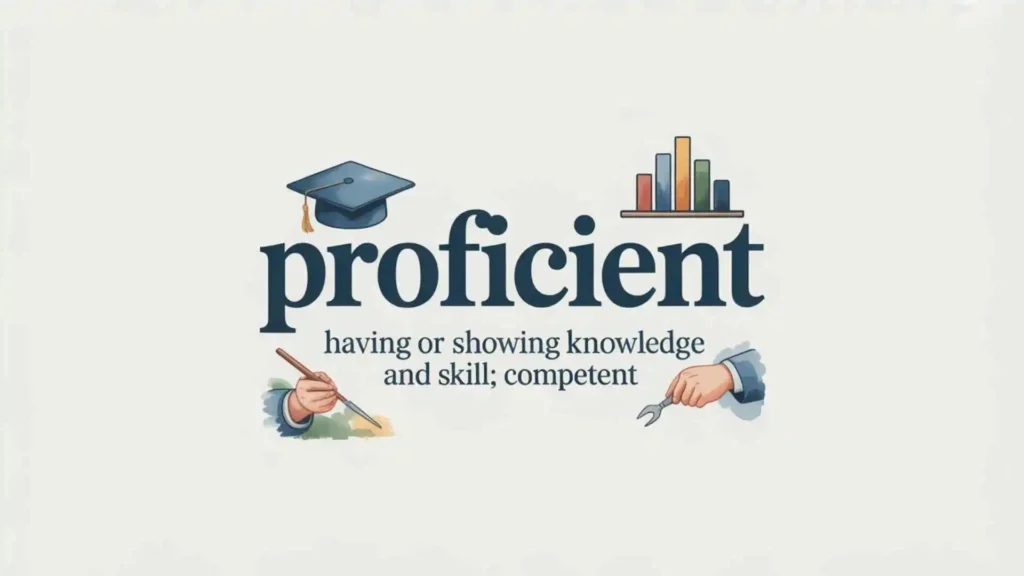
The term proficient refers to having a high degree of skill or competence in a particular area. In simple terms, if you’re proficient at something, you can perform it effectively, efficiently, and accurately in real-world situations.
- Proficient vs Competent: Competence is basic ability, while proficiency demonstrates mastery and communication effectiveness.
- Proficient vs Expert: Experts may push boundaries or innovate, but proficiency shows you consistently succeed under normal conditions.
For example, a student may be proficient in writing, meaning their writing proficiency allows them to express ideas clearly with proper grammar and vocabulary.
Types of Proficiency
Language Proficiency
One of the most common uses of the term is in language learning. Language proficiency measures how well someone can use a language in real-world contexts.
Key components include:
- Oral language fluency: Speaking smoothly with clear speech rhythm and understanding.
- Reading fluency: Ability to read quickly with strong reading comprehension.
- Writing proficiency: Using grammar knowledge and vocabulary expansion to write effectively.
- Listening comprehension: Understanding spoken language in various contexts.
- Spontaneous language use: Communicating naturally without pre-rehearsal.
Language Proficiency Levels Table
| Level | Description | Example in Real-World Context |
| Beginner | Limited vocabulary and grammar | Can introduce themselves and ask basic questions |
| Intermediate | Moderate understanding of grammar, basic conversation | Can discuss daily life topics and read simple texts |
| Proficient | Smooth speech, comprehension, writing | Can work, study, or travel using the language effectively |
| Advanced | Near-native fluency | Can debate, analyze, and teach the language |
| Native | Complete mastery | First language or native language usage |
Organizations like ACTFL (American Council on the Teaching of Foreign Languages) and Language Testing International (LTI) provide structured language testing and certification. Their proficiency scales assess abilities across speaking, reading, writing, and listening.
Professional / Skill Proficiency
Being proficient isn’t limited to languages. It also applies to professional or technical skills:
- Coding, web design, data analysis
- Public speaking or communication skills
- Musical instruments or athletic performance
To achieve proficiency, you must demonstrate consistent performance, pass tests/exams, or obtain certifications that validate your skill assessment.
Example: A software developer who is proficient in Python can solve complex problems efficiently, write clean code, and debug programs without constant guidance.
Academic Proficiency
In academics, proficiency indicates mastery of subjects or concepts. Educational institutions often measure it through:
- Grades and GPA
- Standardized tests
- Projects and practical assignments
Academic proficiency ensures students can apply knowledge effectively, demonstrating real-world language use or technical ability.
Measuring Proficiency
Understanding proficiency is incomplete without knowing how it’s measured.
Formal Assessments
- Language testing: ACTFL, TOEFL, IELTS, CEFR
- Skill certifications: PMP, Microsoft, AWS, etc.
- Academic exams: SAT, GRE, professional licensure
Informal Assessments
- Performance reviews at work
- Oral exercises, listening exercises, writing exercises
- Journaling or diary writing to track language skills improvement
- Self-assessment apps and practice tools
“You cannot improve what you do not measure.” — Peter Drucker
Key Terms and Concepts
Understanding proficiency requires familiarity with certain linguistic and semantic concepts:
Linguistic Terms
- Fluency: Smoothness and flow of spoken word / speech
- Comprehension: Understanding written or spoken language
- Vocabulary: Words you know and use confidently
- Grammar: Rules of sentence structure
- Language flow: Cohesion and rhythm in verbal expression
- Spontaneous communication: Speaking or writing naturally without pre-planning
Skill Development Terms
- Competence: Basic ability to perform a task
- Mastery: Near-expert or expert performance
- Continuous improvement: Ongoing practice to enhance language acquisition or skills
- Practical application: Using skills in real-world situations
Semantic Distinctions
- High proficiency vs low proficiency: Level of command over a language or skill
- High fluency vs low fluency: Degree of smoothness in speech
- Monolingual vs bilingual vs multilingual: Ability to use one, two, or more languages
How to Achieve Proficiency
Achieving proficiency is a structured, ongoing process rather than a one-time goal.
Learning Strategies
- Deliberate practice: Focused, intentional efforts to improve specific skills
- Active recall: Testing yourself to enhance memory retention
- Immersive experiences: Surrounding yourself with real-world contexts
Exercises for Improvement
- Oral exercises: Speaking with conversation partners or in language labs
- Listening exercises: Using interviews, subtitles, and audio resources
- Reading exercises: Daily reading for vocabulary expansion and comprehension
- Writing exercises: Journals, essays, and reports to improve writing proficiency
Feedback & Assessment
- Mentors, teachers, and peer review
- Language evaluation tests from ACTFL or Language Testing International
- Self-assessment tools for language skills assessment
Consistency
Daily practice and exposure accelerate language acquisition and skill development. Even 20-30 minutes a day of targeted exercises improves communication effectiveness over time.
Benefits of Being Proficient
Being proficient offers tangible and long-term advantages:
Career Advantages
- Greater job opportunities
- Higher earning potential and promotions
- Competitive edge in multilingual or highly skilled workplaces
Academic Advantages
- Better grades and performance
- Easier learning of advanced subjects
- Improved cognitive flexibility
Personal Growth
- Increased confidence in spoken word / speech
- Improved communication skills
- Greater cultural understanding and multilingualism
Cognitive Benefits
- Enhanced problem-solving and critical thinking
- Improved language flow and smooth speech
- Easier acquisition of new languages or skills
Common Misconceptions
Many people misunderstand what it means to be proficient:
- Fluency vs Proficiency: Fluency refers to speed and ease, while proficiency reflects overall ability.
- Proficiency doesn’t equal perfection: Minor errors do not mean you are not proficient.
- Proficiency is a journey: Continuous learning and practice are necessary; it is not instantaneous.
Proficiency in Real-World Contexts
Workplace
- Effective cross-cultural communication
- Enhanced performance and adaptability
- Ability to perform complex tasks with real-world language use
Education
- Excelling in coursework and exams
- Participating confidently in discussions
- Demonstrating writing proficiency and reading fluency
Personal Life
- Engaging in hobbies or travel
- Social interactions and building relationships
- Strengthening memory and cognitive skills
Tools, Certifications, and Resources
To measure and improve proficiency, several tools and certifications exist:
| Category | Tool / Organization | Purpose |
| Language Certification | ACTFL, Language Testing International | Formal testing of language proficiency, speaking, listening, reading, writing |
| Professional Skills | PMP, AWS, Microsoft | Certify skill proficiency in technical fields |
| Self-Assessment | Duolingo, Babbel, LingQ | Track language skills, exercises for vocabulary expansion, grammar, oral language fluency |
| Immersive Learning | Conversation partners, internships | Real-world application, spontaneous communication, language flow |
Additional strategies include:
- Diary / journal writing for writing skills
- Interviews for listening practice
- Watching shows with subtitles for learning
- Engaging in language tasks and simulations
Summary & Takeaways
Being proficient is more than a word—it’s a measurable, attainable, and highly valuable skill in language, academics, and professional life. True proficiency combines fluency, grammar knowledge, vocabulary, and the ability to apply skills in real-world contexts.

Asher Blake is a passionate wordsmith whose pen dances between pain and purpose. Known for his emotionally rich quotes and soul-stirring reflections, Asher has become a quiet force in the world of inspirational writing. His words don’t just decorate pages — they reach into hearts, offering comfort, clarity, and courage.
With a background in creative writing and an unshakable love for literature, Asher began his journey by collecting forgotten feelings and turning them into lines that linger. His work touches on self-worth, healing, love, heartbreak, and the small moments that define us. He believes that even a single sentence can light up someone’s darkest day.
Driven by empathy and depth, Asher Blake writes not to impress — but to connect. His quotes are shared across the globe by those searching for meaning, motivation, and emotional release. Whether you’re lost in love, rebuilding your confidence, or simply pausing to breathe, his words feel like they were written just for you.
Books by Asher Blake
“Ink & Ache: Quotes That Feel Like Scars”
A collection of raw, emotional quotes about love, loss, and becoming whole again.
“Still Learning to Breathe”
An inspiring blend of healing quotes and reflections for anyone learning to let go.
“Unfinished Thoughts”
A poetic journey through scattered emotions, fleeting moments, and the beauty of not having all the answers.