
If you’ve spent any time on TikTok, Twitter, or Instagram lately, you’ve almost certainly seen people say they’re standing on business. Sometimes it sounds motivational. Other times it sounds like a warning. And occasionally, it feels like both.
So what does “standing on business” actually mean?
It’s about taking responsibility, following through, and backing up your words with action.
Long answer? That’s what this guide is for.
Below, you’ll find a deep, clear, and human explanation of the phrase, where it came from, how Gen Z uses it today, and when it doesn’t work. No filler. No vague definitions. Just real meaning, real examples, and real context.
A Complete, No-Fluff Guide to the Viral Phrase, Its Origins, Real Meaning, and How to Use It Correctly
The Core Meaning of Standing on Business
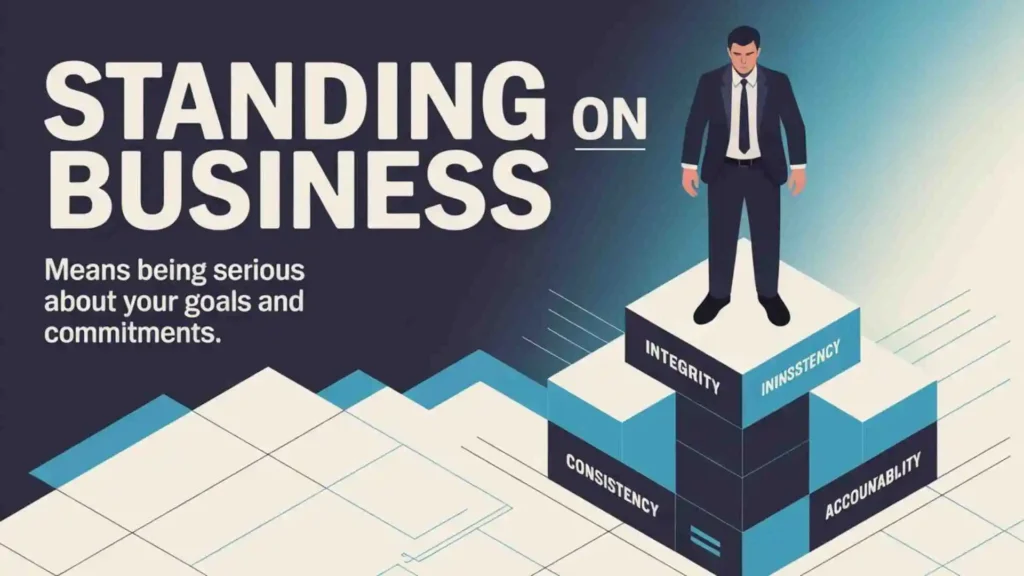
At its core, standing on business means:
Handling your responsibilities and sticking to your word, even when it’s uncomfortable.
When someone says they’re standing on business, they’re saying they:
- Take accountability seriously
- Follow through on commitments
- Honor boundaries
- Do what they said they would do
It’s not about talking.
It’s about action.
That’s why people often compare it to phrases like:
- taking care of business
- putting your money where your mouth is
- walking the walk
However, standing on business carries more weight. It implies firmness, discipline, and sometimes confrontation.
Why the Phrase Hits So Hard Right Now
Language doesn’t go viral by accident.
Standing on business exploded because it fits modern life perfectly.
People today feel overwhelmed by:
- endless work expectations
- blurred boundaries
- performative motivation
This phrase cuts through the noise. It signals decisiveness, self-respect, and consistency.
You’re not just busy.
You’re not just talking.
You’re standing on business.
Where Did Standing on Business Come From?
Roots in AAVE (African American Vernacular English)
The phrase didn’t start on TikTok.
It comes from AAVE, where “business” has long meant:
- personal matters
- responsibilities
- values
- principles
In this context, standing doesn’t mean standing physically.
It means holding your ground.
That cultural foundation matters. The phrase carries history and intent, not just trend energy.
The TikTok Explosion in 2023

While the phrase existed before, TikTok made it mainstream.
Three major factors pushed it viral:
| Trigger | Impact |
| Drake’s song Daylight | Introduced the phrase to a global audience |
| Druski’s viral skit | Added humor and critique |
| Meme culture | Turned it into everyday slang |
Drake repeats standing on business in Daylight, released in 2023, which instantly amplified interest. Soon after, Druski mocked people who claimed to stand on business but didn’t follow through. That contrast made the phrase stick.
What Standing on Business Actually Looks Like in Real Life
Let’s move beyond theory.
Here’s how the phrase plays out day to day.
Standing on Business at Work
In a professional setting, standing on business means:
- meeting deadlines
- owning mistakes
- respecting time
- refusing unpaid labor
Example:
“My boss asked me to stay late without clocking in. I stood on business and said no.”
This isn’t laziness.
It’s workplace fairness.
Standing on Business in School
For students, the phrase often signals discipline.
Example:
“I stopped procrastinating this semester. I’m standing on business.”
Here, it means:
- managing workload
- prioritizing goals
- maintaining focus
Standing on Business With Money

Financial responsibility is a huge theme.
Standing on business can mean:
- paying off debt
- building savings
- refusing impulsive spending
Example:
“I said I’d get my finances together, and I did. I’m standing on business.”
Standing on Business With Boundaries
This is where the phrase gets serious.
In this context, it means:
- enforcing limits
- saying no
- protecting your peace
Example:
“I told my ex not to text me. When they did, I ignored it. I stood on business.”
That firmness matters.
The Emotional Core Behind the Phrase
People don’t just say standing on business for style.
They say it because it communicates:
- confidence
- self-respect
- integrity
- resilience
It tells others you’re not easily pushed around.
It also tells yourself that you can trust your own words.
How to Use Standing on Business Correctly
Tone matters.
Used right, the phrase sounds powerful.
Used wrong, it sounds empty or performative.
Use It When Action Is Involved
Say you’re standing on business when you:
- completed a tough task
- followed through on a promise
- enforced a boundary
Good example:
“I committed to therapy and stuck with it. I’m standing on business.”
Don’t Use It for Hypotheticals
Talking about what you might do isn’t standing on business.
Bad example:
“I’m about to stand on business someday.”
That’s just talk.
Standing on Business vs Similar Phrases
Here’s how it compares to common alternatives:
| Phrase | Difference |
| taking care of business | more casual, less firm |
| walking the walk | focuses on action, less on boundaries |
| standing your ground | more confrontational |
| putting your money where your mouth is | similar intent, less cultural weight |
Standing on business combines all of these.
Why Gen Z Loves This Phrase
Gen Z values:
- authenticity
- boundaries
- self-definition
This phrase hits all three.
It rejects:
- hustle culture without payoff
- fake productivity
- empty motivation quotes
Instead, it promotes discipline with purpose.
Common Mistakes People Make
Let’s clear these up.
Mistake 1: Using It as a Threat
Saying “I stand on business” without context sounds aggressive.
The phrase works best when explained by action.
Mistake 2: Overusing It
Like any slang, overuse kills impact.
If every sentence includes it, the phrase loses power.
Mistake 3: Ignoring the Cultural Roots
Because the phrase comes from AAVE, using it respectfully matters. It’s not just a meme. It’s a language with history.
Examples Across Different Situations
Career Growth
“I said I wanted a promotion, so I took extra training and delivered results. I stood on business.”
Health Goals
“I stopped skipping workouts and fixed my sleep schedule. I’m standing on business.”
Relationships
“I communicated my boundaries clearly and enforced them. Standing on business felt hard, but necessary.”
Related TikTok Slang You’ll See Alongside It
Understanding standing on business gets easier when you know its neighbors.
| Term | Meaning |
| rizz | charisma or charm |
| it’s giving | expressing a vibe or energy |
| girl dinner | low-effort meals |
| beige flag | neutral personality trait |
| ick | sudden turn-off |
These terms often appear together in Gen Z slang spaces.
Why the Phrase Isn’t Going Away Soon
Some slang fades fast.
This one won’t.
Why?
Because standing in business isn’t just trendy.
It names a behavior people actively want.
In a world full of noise, it values consistency.
The Deeper Psychology Behind Standing on Business
Psychologically, the phrase taps into:
- self-efficacy
- identity alignment
- internal accountability
When actions match values, confidence grows.
That’s what the phrase captures in three words.
When You Shouldn’t Use the Phrase

Not every moment calls for it.
Avoid using standing on business when:
- joking lightly
- describing minor tasks
- talking hypothetically
Save it for moments that matter.
Final Thoughts
At the end of the day, standing on business means this:
You do what you say you’ll do.
You honor your boundaries.
You follow through, even when it’s hard.
It’s not loud.
It’s not flashy.
It’s solid.
And that’s exactly why the phrase resonates.

Ethan Cole is a writer fueled by emotions, driven by truth, and inspired by the power of words. Known for his ability to distill complex feelings into short, striking lines, Ethan has become a go-to name for readers seeking comfort, motivation, and clarity through quotes.
With a background in literature and a lifelong love for poetic expression, Ethan blends simplicity with depth. He writes not just to be read, but to be felt. His work dives into themes of heartbreak, healing, mental strength, and the beauty of being human — making his words resonate across generations.
Ethan believes that even a single sentence, when written with honesty, can become a turning point in someone’s life. Whether it’s a quote to mend a shattered heart or one to spark a dream, he crafts each line with intention.
Outside the world of writing, he enjoys black coffee, rainy evenings, and observing life in its rawest form — because that’s where the real stories hide.
📚 Published Works by Ethan Cole
“Fragments of a Shattered Sun”A poetic journey through heartbreak, loss, and the light that follows even the darkest nights.
“Ink & Resilience”A bold mix of motivational quotes and raw reflections on self-growth, courage, and rising again.
“The Weight of Quiet Things”A deeply personal collection of short quotes and musings for those who feel deeply but speak softly.